Digital inclusion: how is it going in Europe?

Digital inclusion: how is it going in Europe?

Digital inclusion: how is it going in Europe?

Digital inequalities, more often referred to as the “digital divide”, are an obstacle for those who already have difficulties in using them or who do not have access to them. To fill these gaps, public authorities are acting at both national and European level, in conjunction with local authorities. For example, the European directive 2018/1972 creates the notion of “adequate high-speed Internet access service” and gives more rigid criteria for the definition of an Internet connection. This directive is then transposed into the national laws of the Member States, notably through action plans or an equivalent tool.

Here are some examples from four EU countries.

site kit d'inclusion numérique
Overview of the Digital Inclusion Kit launched by the French authorities
Source: Mission société numérique (screenshot)

In France, a national plan for digital inclusion
The French state wishes to detect the public in difficulty in order to diagnose their shortcomings in digital terms. This is done by supporting the MOOC proposed by MedNum and the Centre national de la fonction publique territoriale (CNFPT) “on the challenges and good practices of digital mediation in the service of the digital transition of the territories for the agents of local authorities”.


Young people in civic service are also targeted, as the Ligue de l’Enseignement will be mobilised to guarantee the quality of the interventions of these young volunteers. The aim is to raise awareness of digital issues among the target audiences, and also to equip these young volunteers.

The digital agenda for Spain and its four key objectives
Accessibility, literacy, equality, employability. These are the four points on which Spain has decided to focus its digital agenda.
First of all, this plan aims to erase the grey areas of the kingdom. Secondly, the oldest and least qualified people are also targeted in this rise in skills planned by the State. In addition, the Spanish government is seeking to bridge the differences between men and women in terms of access to digital technology. Finally, continuing education is targeted, since the State is seeking to develop the digital skills of everyone throughout their working lives.


To achieve these objectives, Spain aims to guarantee Internet access to its entire population at a speed of at least 100Mb/s. 140 million will be invested to achieve this by 2025.

cornwall
Two women working on a computer
Source: Gobierno de España
Parlement fédéral belge
The Palace of the Nation, which hosts the Belgian federal parliament
Source: Wikipedia, Palace of the Nation in Brussels

A Digital Belgium to bridge a digital divide
The Belgian authorities have highlighted the digital divide, which mainly affects certain age groups, the least educated and those on the lowest incomes. These three degrees of digital divide are to be eliminated by several means. For example, the idea is to strengthen cooperation between the regions, the municipalities and the State, while involving all the players to create genuine e-inclusion, including in public services.
Indeed, 10% of Belgian households still do not have access to the Internet. The objective is therefore to guarantee high-speed Internet access for all, particularly in the rural municipalities of Wallonia.
The strategy adopted by Belgium is also to allow as many people as possible to access digital services, whether by making the prices of computer equipment and subscriptions accessible. At the same time, the government wants to give everyone the opportunity to improve their skills, while setting up awareness campaigns to highlight good practices. Nevertheless, since the development of this Digital Belgium plan, the federal government has indicated that it wants to strengthen it rapidly.

In Portugal, an action plan for the digital transition
“Digital empowerment of people, digital transformation of businesses and digitalisation of the State” are at the heart of this plan launched in March 2020 and validated by the Council of Ministers. In this case, the various strategies already in place or developed in Portugal, at local or national level, have been pooled to create a real national synergy. Thus, this plan aims to juggle different sectoral policies to achieve an effective and inclusive digital transition.

Note the Estonian inspiration in this Portuguese plan. An e-Residency programme will enable Portuguese residents living abroad to use an online version of public services. In parallel to this measure, the country of the Carnations wants to create full online access to the 25 most used public services.

Through different approaches, the expected results seem to be the same in these different countries: to bridge the digital divide that exists in our societies. This concerns the oldest groups, the most disadvantaged and those living in rural areas. These three groups are the keystone of the public authorities’ action in this area, since they are the most likely to be in digital insecurity. Between the ambitious targets and the digital divide, however great it may be, national and local authorities will have their work cut out to ensure Internet access for everyone.

Sources:

– Agence nationale de la cohésion des territoires, Plan national pour un numérique inclusif, 2018

– Conseil central de l’Économie / Centrale Raad voor het Bedrijfsleven, Vers une politique d’inclusion numérique en Belgique, 2020

– Ministro da Economia e Transição Digital, Portugal Digital, 2020

– ePortugal, Governo lança plano de ação para a transição digital, 2020

– Ministerio de asuntos económicos y transformación digital, Plan de inclusión digital y empleabilidad, 2014

G7 Summit: why does the British Southwest matter for the digital sector?

G7 Summit: why does the British Southwest matter for the digital sector?

G7 Summit: why does the British Southwest is so important for the digital sector?

The G7 Summit is currently taking place in the seaside resort of Carvis Bay, Cornwall, UK. The choice of this region was undoubtedly made to showcase its rugged rocky coastline and the bucolic charm it inspires. But it is simplistic to reduce the peninsula to this caricature. The British South West has recently made green tech its watchword, despite being one of the least densely populated areas in England.

Here’s how the region has converted to this innovative sector.

G7 leaders
The leaders of the G7 countries in Cornwall, 11th of June 2021
Source: G7 UK 2021 Flickr Channel

Cornwall, a rural and innovative region
Only 600,000 inhabitants, large towns of around 20,000 inhabitants, and 56% of the population living outside the cities. On paper, Cornwall could be seen as a very rural region, far from the hustle and bustle of London. Yet this is where the mistake is made. Cornwall is home to many innovative tech organisations, again in a variety of forms. The pandemic has further demonstrated that the digital sector is pivotal to the whole region. For example, just over 4,000 online shops opened across the South West during the crisis. This is necessary in a region that relies heavily on tourism, but not only. Fishing and farming are also two important sectors of the whole local economy. “Agriculture has been innovating for centuries and we are seeing this now with the emergence of agritech. Investment and innovation must accelerate if we are to truly prosper economically,” says Paul Coles, local director of British Telecom.

Superfast Cornwall, a project to improve everyday rural life
Like other European countries, the UK has a digital rollout plan. £75 million has been invested in rural areas alone, of which most of Cornwall is part. This ambitious action by the UK government has also been to bridge a digital divide, with 17% of rural areas not having access to broadband in 2017. Worse still, in 2011, a study showed that 20% of adults living in the region had never used the internet.

Faced with this situation, the Superfast Cornwall project was launched the same year. Funded by the ERDF, British Telecom and the Cornish local authorities, this project aims to break the image of digital notspot that was given to the peninsula.
To carry out the project, the iCornwall platform was created. This was a group of representatives from local organisations, diverse but with a common goal: to help as many people as possible through digital tools. Nevertheless, the project’s proponents have understood that providing the area with a decent digital infrastructure is central. But this is far from enough, especially given the sociological make-up of Cornwall, where not everyone has had the opportunity to use digital tools in their lives. “The problem is that technology is moving so fast that people are being left behind,” says Sandra Coak, a community centre worker in Pendeen, a coastal village near the town of Penzance. That’s why digital courses have been provided free of charge to people in the local communities. Over a period of several weeks, these courses were held in many towns and villages in the region, mainly for the elderly.

cornwall
St. Agnes Heritage Coast, in Cornwall
Source: Pexels (image free of rights)
euses OECD conference
The digital hub of Pendeen, a remote village close to Penzance
Source: Superfast Cornwall

This type of digital inclusion also goes beyond simply training the public and installing effective infrastructures. Municipal services, from the town hall to the library, have been transformed into digital meeting places. Residents can go there to access a computer, for example to do administrative procedures, or to use it for recreational purposes. Improved access to the internet in the region has also led to other innovations, particularly in the area of health.

The University of Plymouth, located in a large Cornish city of the same name, is very involved in these cross-cutting issues. Studies have been carried out to see the effects of digital medicine, particularly for treating psychological disorders. For example, e-health has tried to treat people suffering from dementia using robotics or the remote presence of people qualified in these pathologies.

Between successes and limitations, digital infrastructures at the service of the local economy
The health crisis has also prompted the region to review its model, or rather, to highlight its successes. “If we really want to rebuild the economy in a way that has the least impact on our environment, we need to go through the technology sector,” says Paula Byers, the founder of Digital Northern Devon. She believes that the digital infrastructure that has been greatly improved – or simply built – has made up for the difference in economic development that existed with other parts of Britain. Companies have been able to set up in the area, such as Jurassic Fibre, which would not have been able to set up without the infrastructure projects of the last ten years. The latter aims to provide “world class broadband for 300,000 premises” of organisations in the South West.

European flags
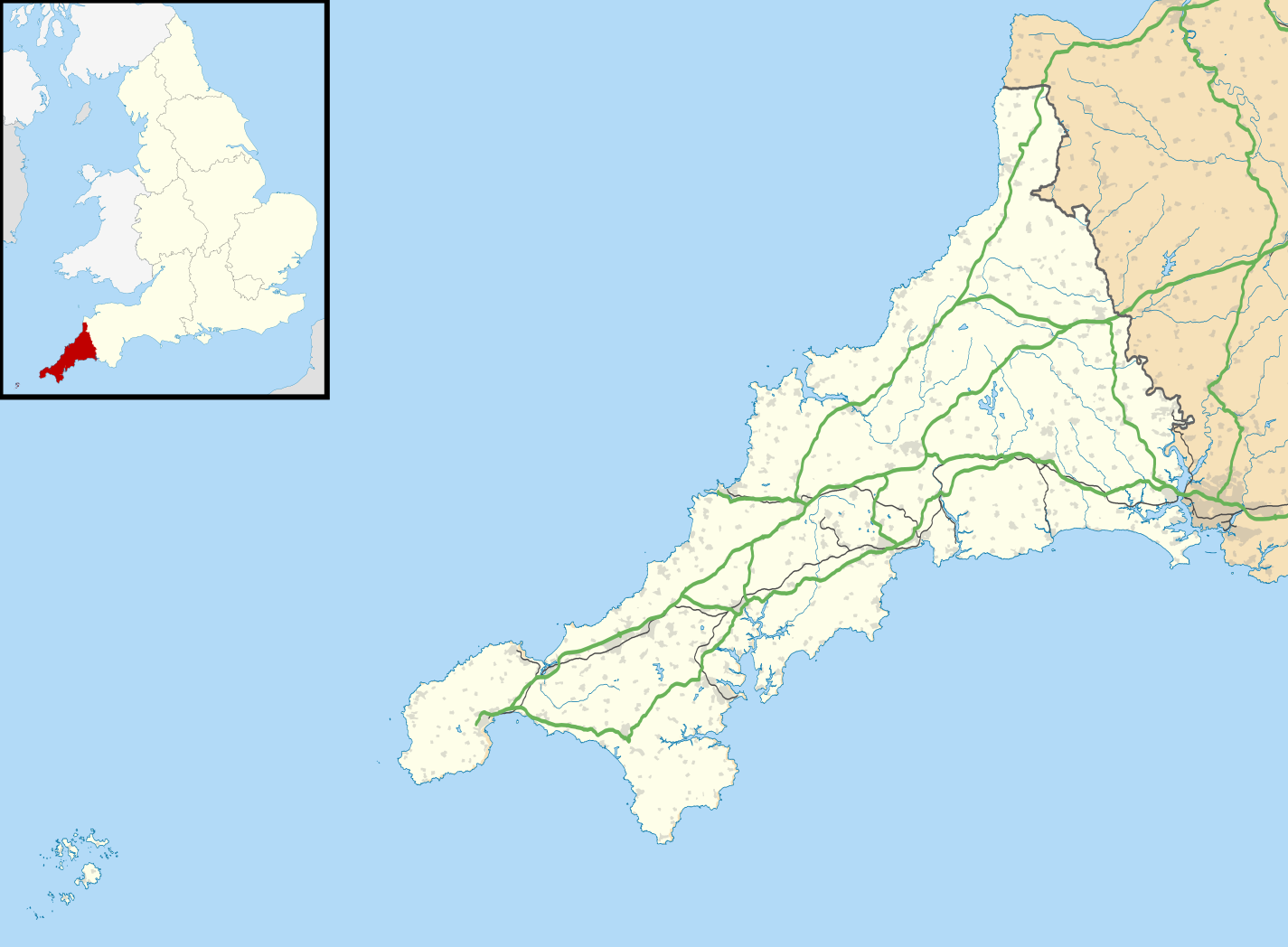
Localisation of Cornwall in the South West of England
Source: Wikipedia (image free of rights)

Nevertheless, the choice to develop fibre first in one region rather than another can have perverse effects. “Just as the rollout of railways in the 19th century defined the winners and losers for the next hundred years, the rollout of fibre to the premises networks will do the same in the 21st century. Our intention is that the South West will be one of the winners. So says Michael Maltby, CEO of Jurassic Fibre. Let’s hope that fibre doesn’t put territories in competition with each other and leave some behind. But there is no doubt that recent European projects have added value to Cornwall. One of the reasons for the slight increase in the region’s population, says Maltby, is that its digital infrastructure has definitely improved. As well as the picture postcard image that Cornwall offers, it is also becoming a favourite with the populations of the surrounding major cities, starting with Bristol, the nearest major city before London.

mannheim stadt
A view of Port Isaac, UK, a small village north of Newquay.
Source: Pexels (free of use)

The UK has chosen to move towards a vision of digital as a basic need. But access to the Internet is only one side of the coin, and the other side must ensure that these tools are understood. The demographic composition and geographical distribution of Cornwall’s population has forced the region to turn to digital technology to overcome challenges. Between the digital divide and the remoteness of many from major cities – and therefore from decent access to the internet, the peninsula has quickly become a model for the rest of the UK, but remains “largely neglected” within the European Union.

Sources:

– European Network for Rural Development, Cornwall-UK, Steps towards a digital rural region, 2019

– Olivier Vergnault, Hannah Finch, “Why the South West’s tech sector has been a saviour of the Covid-19 crisis”, Business Live, 2020

Editorial – DSA and DMA: Can the EU take on Big Tech?, March 2021, by Arnaud Castaignet

Editorial – DSA and DMA: Can the EU take on Big Tech?, March 2021, by Arnaud Castaignet

In December 2020, the European Commission presented the Digital Services Act (DSA) and Digital Markets Act (DMA). Both are aimed at regulating digital platforms and clarifying the policing responsibilities. These new pieces of legislation are billed as urgent pieces of regulation, mostly because of concerns that the likes of Google and Facebook have become too powerful.

Last week, Margrethe Vestager, the executive vice-president of the EU and competition commissioner, even quoted David Bowie when she urged MEPs to speed up adoption of the legislation, saying “so now’s the moment when you can be heroes”. The European official has said she hopes an agreement between the European Parliament, member states and the European Commission can be reached by “spring 2022”.
The DMA focuses on gatekeepers’ behaviours and their impact on market dynamics, while the DSA seeks to consolidate various separate pieces of EU legislation and self-regulatory practices that address online illegal or ‘harmful’ content and to harmonise the rules applicable to the provision of digital services across the EU.

The context in which the two texts are now being discussed is highly favourable to a tough position for the EU against platforms. The suspension of the social media accounts of former U.S. President Donald Trump by Twitter, Facebook, Instagram, Snapchat, and others this winter sparked a lot of controversy in Europe. Without defending Donald Trump’s quotes, German Chancellor Angela Merkel considered the move “problematic.” The EU Commissioner for the internal market, Thierry Breton, found it “perplexing” that Twitter’s CEO Jack Dorsey could simply pull the plug on POTUS’s loudspeaker “without any checks and balances.”. From a European point of view, governments and institutions should regulate, not the company themselves without any legal framework but their internal rules. Governments and institutions ensure the freedom of expression, and set boundaries such as hate speech and incitement to violence, and companies must comply to laws.

Paradoxically, for some time now, European politicians have been trying to convince online platforms to “do more” to police the content of their users. National laws such as the German NetzDG, the Austrian KoPlG and the unconstitutional French Avia bill all require more effective moderation of online spaces, including more and faster removals. But “online gatekeepers” making arbitrary decisions about speech they allow online remains an issue.
The key here is that the DSA aims to regulate the process and not to regulate the speech. The idea is to strengthen due process, clarify notice and take down procedures, improve transparency of the decision making and ensure redress mechanism for removal or blocking decisions. Platforms would face the prospect of billions of euros in fines unless they abide by new rules across fields including advertising transparency, illegal content removal, and data access.

The DMA is the other key legislation that the Commission wants to implement to tackle the complex challenges facing the EU Digital Single Market, and improve the gatekeepers’ behaviour. While the Commission has not named any companies, it has proposed criteria that are sure to catch Google, Facebook, Amazon, Apple, Microsoft and SAP, among others. In the DMA, it defines a gatekeeper as a platform that operates in one (or more) of the digital world’s eight core services (including search, social networking, advertising and marketplaces) in at least three EU countries and:
  • Has a significant impact on the internal market (defined quantitatively as an annual turnover of €6.5 billion or a market capitalisation of €65 billion);
  • Serves as an important gateway for business users to reach end-users (user base larger than 45 million monthly end-users and 10,000 business users yearly);
  • Enjoys an entrenched and durable position or is likely to continue to enjoy such a position (meets the first and second criteria over three consecutive years).

A platform that meets these quantitative thresholds is labelled a gatekeeper. The Commission would also be empowered to alter the thresholds as technologies change, and to conduct market investigations to look for new gatekeepers.

Consequently, the DMA only targets the truly massive corporations. This way, companies and potential competitors to the Big Tech companies are not burdened with undue regulation. Basically, the DMA would list “Do’s” and “Don’ts” for big tech companies.
For instance, no self-preferencing: a prohibition on ranking their own products over others;
Data portability: an obligation to facilitate the portability of continuous and real-time data;
No ‘spying’: a prohibition on gatekeepers on using the data of their business users to compete with them;
Interoperability of ancillary services: an obligation to allow third-party ancillary service providers (eg payment providers) to run on their platforms;
Open software: an obligation to permit third-party app stores and software to operate on their OS.

The DMA states that the European Commission alone will be responsible for enforcement, meaning they would investigate any alleged violations and hand out penalties to any gatekeepers that violate the DMA’s new rules. Sanctions could go from fines, to periodic penalty payments, additional penalties, including potential “structural remedies”.

Time will tell if the DSA and the DMA manage to change the way the Internet operates and tackle the accumulation of power in the hands of a few companies that happened in the last decade. In any case, before we can create an internet that puts people first, it is important to regulate the domination of a few and support competition. The proposals for a Digital Services Act and a Digital Markets Act are therefore meant to protect Europeans as consumers if technology poses a risk to fundamental rights.


Author
Arnaud Castaignet, Tech European expert and Administrator of SOGA EU
Tallinn, Estonia
March 2021
EU Social Tech Public Affairs Web Review

EU Social Tech Public Affairs Web Review


As the COVID health crisis19 is forcing a large proportion of Europeans to remain at home, Social Economy, Digital inclusion, Democracy defense are more than ever accurate. On such matters, European activity is not slowing down. Here is a panorama on EU Public Affairs news on our subject (Tech x Social) : Digital Service Act, digital ambitions of the German Presidency of the EU, Data Governance Act, European Action Plan for Democracy and ambitions for the ‘next world’.

Digital Service Act : imposing a Tech European model

From Brussels, Thierry Breton, European Commissioner for the Internal Market is fully mobilised on the Digital Services Act: “As part of the European Digital Strategy, the European Commission has announced a Digital Services Act package to strengthen the Single Market for digital services and foster innovation and competitiveness of the European online environment”. The main aim is to reform the Directive on electronic commerce dating from 2000 with regard to the obligations and responsibilities of platforms and to develop the competition rules. It also provides for the regulation of online content, reinforcing the responsibility of intermediaries in the “fight against illegal content and its amplification”. It thus includes the inclusion of online hate in criminal offences at European level. “Platforms must be more responsible and accountable, they must become more transparent. It is time to go beyond self-regulatory measures” says Vera Jourova, European Commissioner for Values and Transparency.

Very clearly, the European Commission’s ambition is to tackle the ‘too big to care’ monopoly, which the Commission believes crushes competition and distorts the smooth functioning of the internal market. The arm wrestling, as we suspected, promises to be tough. Thierry Breton, who wants to take the digital economy out of the “Far West” era, does not hesitate to directly question the bosses of Silicon Valey: “Don’t try to play the smartest game. Pay your taxes if you have to pay them. Don’t resort to tax havens. Pay your taxes,” he told Facebook’s CEO last May, before Google CEO Sundar Pichai apologised in October for his more than aggressive internal lobbying practices. 

The German rotating presidency of the Council of Europe, which ends in December 2020, also makes digital technology one of its major subjects, along with the ecological transition. “In order to stand out internationally as a community of values, we must therefore position ourselves even better on strategic future issues such as climate change, refugees and migration, the rule of law and digital transformation”, said the German Foreign Minister when presenting an ambitious agenda. This also includes the development of a European data and 5G infrastructure and support for research, particularly in the field of artificial intelligence. The Data Governance Act, a regulation on data governance proposed by the European Commission, should thus inflate the pool of data that will feed AI systems and start-ups, and in fine should encourage the emergence of these large sectoral data spaces. 

European Democracy : inclusion of people, social economy and civil society are key

The other major topic of this new school year is Democracy. It is the common thread of the digital regulation carried by Europe. And it is a matter of urgency. On the one hand because the breeding ground for mistrust is becoming more and more fertile, particularly because of social networks. According to a survey carried out by the Jean Jaurès Foundation in February 2019, “one Frenchman in five agreed with at least one conspiracy theory” and “43% of those polled agreed that the government would be in cahoots with the pharmaceutical laboratories to hide the reality of the harmfulness of vaccines”. European politicians are also singing the praises of this questioning of our democratic values. While the European recovery plan was painfully voted through, Hungary and Poland decided to apply their veto refusing “that the payment of Community funds should henceforth be conditional on respect for the rule of law”. One point of consensus, whatever our values: they cannot be bought with billions of euros of aid.

The European action plan for democracy, which has been under the media radar, was the subject of an online consultation this summer. Through the accumulation of new constraints and recommendations for all actors in the democratic game, it must both strengthen the integrity of elections, guarantee media freedom and provide solid strategies against disinformation. It is scheduled for December. 

After the first containment, calls for the “next  world” had bloomed like flowers in the spring. Despite this regulatory activism, the European project is taking a beating. One would have dreamed that European news coverage would be as dense as it was during the American elections. Wishful thinking that fades like leaves in autumn. Yet there are some calls that resonate more than others, such as that of the first European democratic institution: David Sassoli, President of the European Parliament. “We must ensure that the European policies supported by the resources we pool will encourage a transformation of our economies in the years to come, in the service of respect for the environment, social cohesion – which has been particularly affected in the current health context – and the fight against all forms of inequality,David Sassoli declared last September. He also recognised that “Europe needs more than ever to support the voluntary sector” and that “the harmonisation of the single market should not be limited to companies but should also concern the voluntary sector“. In the meantime, a European regulation on participatory financing to protect investors from financial losses will have to be sufficient. 

But those who have the most to lose are ultimately the most precarious among us. What appears to be self-evident takes on even greater prominence in the DESI ranking, which reveals that the digital and economic divides overlap.  In that prospect, Cedric O, French Secretary of state for Digital affairs, just  announced a budget of €250 million (40% EU funding) on inclusive digital on the NEC 2020. 4,000 digital advisers will be recruited by local authorities and associations.

For all these mentioned prospect and because Social Economy and Civil society are both a motor for a more sustainable and prosperous economy for all in Europe, they have to be fully involved in all public policies making. This is also what the European Platform for Philanthropy is calling for


By Nils Pedersen, President of La Fonda Asso and Vice-President of SOGA EU for Public and Academic Affairs


Paris, november 2020


EU Digital Policies : Digital Society index, Digital Service Act and more

EU Digital Policies : Digital Society index, Digital Service Act and more

As every trimester, our EU Tech expert Arnaud Castaignet delivers his analysis on the last EU Tech data and policies. From the Digital part of the State of European Union Speech to the last editions of the European Digital Society Index, including the debates on Digital Service Act in Brussels, here is Arnaud’s sum up of what Social Good organisations must retain of the last EU tech news. 

Ursula von der Leyen, President of the European Commission, presented on September, 16th to the European Parliament her vision in her first State of the European Union address. Since she got appointed, a strong focus has been made on the EU Green Deal. This speech was the opportunity to highlight the Commission’s other top priority: “Europe’s Digital Decade”. 

Tech and digital will have a great importance in the Next Generation EU fund and will be backed up by 20% investment in digital from it, meaning €150bn of the EU’s €750bn recovery fund will be spent on digital projects. Three focus areas have been identified: industrial data, AI and infrastructure.

Talking about industrial data (as opposed to consumer data) shows that the EC will focus on the development of a data economy, hoping to reap the benefits of the fact the amount of industrial data in the world will quadruple in the next five years. The EC is pushing forward with plans to develop common data spaces hosted on a new cloud platform, GaiaX, in energy and health sectors for instance, and is looking forward to support cooperation between start-ups, companies, SMEs, researchers. When it comes to consumer data, Von der Leyen considers that Europe “has been too slow and is now dependent on others”.

On AI, the President of the European Commission actually pushed new AI governance laws back. When she was elected last November, she promised to introduce AI legislation within the first hundred days of her presidency. During her speech, she mentioned that it would be proposed next year, with “a human-centric approach” to rules and regulation. It is worth noting that she also propose a secure European e-identity, that will allow citizens to use it anywhere in Europe to do anything from paying taxes to renting a bicycle, and will guarantee control over personal data, which may sound similar to principles of Estonia’s e-identity.

Infrastructure investments should also be a strong focus in the road to “Europe’s digital decade”. It is more than needed given that digital divide remains very important in Europe as highlighted in the Digital Economy and Society Index (DESI), a composite index that summarises relevant indicators on Europe’s digital performance and tracks the evolution of EU Member States in digital competitiveness. Finland, Sweden, Denmark and the Netherlands scored the highest ratings in DESI 2020 and are among the global leaders in digitalisation. These countries are followed by Malta, Ireland and Estonia. Some other countries however still have a long way to go, in terms of infrastructure but also human capital and ability to use Internet services and technologies. Most of them are among the countries with the lowest GDP in the EU (Bulgaria, Romania and Greece, for instance) or strongly affected by Covid19 and its economic consequences (Italy). Therefore, there is a high risk that both digital divide and economic inequalities may deepen. It is worth noting that the biggest countries are not necessarily the most digitally advanced: France is only ranked 15th overall and even 18th when we focus on connectivity, according to DESI index.

The pandemic has exposed the stark reality of Europe’s digital divide. While countries and regions with good internet connections have been able to continue living life with at least a semblance of normality, others have not been so lucky. Of those living in rural areas, 40 per cent still lack access to fast broadband. The investment boost through NextGenerationEU will look to drive expansion to these areas. The investments will be focused on secure connectivity, on the expansion of 5G, 6G and fiber.

This State of the Union speech shows that digital and environmental transitions will be the key priorities of the EU in the coming years and that these transitions are deeply connected. Digitalisation is clearly considered as critical to achieve environmental transition, particularly in urbanism (smart cities), mobility and decarbonisation of the economy and the industry. Again, the main risk is that the same countries might be the winners. Denmark, for instance, is both among the leaders in digitalisation and one of the countries whose smart cities initiatives will help decrease the most carbon emissions. 

Meanwhile, in Brussels, the Digital Services Act Package is the most important text for the EU digital economy that will shake up discussions between the Commission and the Parliament until the end of the year. It is an ambitious arsenal to tackle both the dominance of the digital giants and their policies on moderation. It is being led by Thierry Breton, European Commissioner for the Internal Market. In a recent interview with the newspaper Le Monde, he explains that the regulation of social networks “is intended to be dealt with at the European level”. Many of the measures are based on the French law on confidence in the digital economy (LCEN), which in France governs the same sector. The Digital Services Act also provides that the platforms can identify and locate Internet users posting under a pseudonym “if necessary”. In case of breach, the sites could be financially sanctioned or “be prohibited from accessing the internal market of the European Union”. For the platforms concerned, the calculations would be made according to a threshold of audience “yet to be determined”. The discourse is quite clear, however, and targets sites with “much larger audiences than traditional media, which gives them responsibilities similar to those of an editorial director or content editor”. Apple, Google and Facebook could be put on a “black list” established by the European Union (EU). As reported in the Financial Times, the EU institutions would be developing stricter rules to regulate the digital services market and impose new rules on the biggest players in the market, both in terms of business practices and data sharing and transparency on data collection. large companies to change their business practices. This would include forcing America’s mastodons to share their data and to be more transparent about how they collect it, according to specific criteria.
Discussed in Parliament in week 43, the own-initiative reports by Alex Agius Saliba (S&D) in the Internal Market Committee (Imco), Tiemo Wolken (S&D) for Legal Affairs (Juri) and Kris Peeters (EPP) for Civil Liberties (Libe) were adopted, almost without amendments.

For More Information

The Digital Economy and Society Index – DESI 2020

DESI 2020: Questions and Answers

Country performance in digital

Data Visualisation Tool

DESI 2020 methodology

Digital technologies – actions in response to coronavirus pandemic

Communication on Shaping Europe’s Digital Future