Social Economy Action Plan: a first awareness on digital transition?

Social Economy Action Plan: a first awareness on digital transition?

Social Economy Action Plan: a first awareness on digital transition?

‘An impressive public policy launched by the EU, which offers a positive project for the EU’. With these words, the team of our partner Social Economy Europe welcomed the Social Economy Action Plan, which will significantly improve a sector in which 6.3% of the EU population is employed. 38 concrete actions will be put in place over the next 9 years to help a sector that is destined to be more and more present in the daily life of EU citizens. One month after the presentation of this plan by Commissioners Schmit and Breton, let’s take a look at some of the highlights of this unprecedented, innovative and ambitious policy document.

Finals Social Economy Awards
From left to right : Marta Lozano Molano (Wazo Cooperative), Tamsin Rose (moderator), Sofi Friedland (Just Arrived) and Stefan van Tulder (Talent Data Labs) talking about new forms of alliances existing in the social economy during the presentation of the Action Plan in Brussels, on 16 December 2021
Source: European Commission
Conference FNAF 2021
Persons in the attendance of the presentation of the Social Economy Action Plan discussing
Source: European Commission

Between assessments and concrete actions, an ambitious plan for Europe
In its drive to include the most disadvantaged people in labour markets and society, “the social economy is a real pillar that provides essential services” to these same groups. Many EU citizens have access to sustainable employment through the social economy. Indeed, depending on the country, between 0.6% and 9.9% of the population work in this essential sector. However, despite the importance of the sector and the values it promotes, the social economy remains unknown to far too many people.

Nevertheless, the Action Plan explicitly mentions the legal forms of organisations in the sector: cooperatives, foundations, social enterprises, mutuals, and others, which fall within the scope of these new regulations. Measures will be put in place to facilitate the work of cross-border organisations in the sector, both in terms of legislation and taxonomy. These measures will, among other things, help to better anchor the social economy at regional and local level.

In parallel to this issue, the ecological and digital transition will have a key place in the European social economy of tomorrow. There is still a long way to go to get there, even if the ambitions of the action plan are strong to give social economy structures the keys to develop. Several points echo what the Social Good Accelerator has been advocating since its creation in 2018.

Improve the access to fundings and grants
The social economy action plan is accompanied by changes in the line of European budgets in this area. Over two periods of structural investment funds, the differences will be noticeable. Indeed, in the 2014-2020 period, almost 2.5 billion euros have been mobilised for the social economy at EU level. For the next period, the European Commission has indicated its interest in increasing budgets in this area. These ambitions are anchored in the dual objective of developing the social economy, but also of moving towards the success of the next major European meetings for the sector.

In 2023, the EU Council should have adopted all the necessary recommendations for the development of the social economy, before adopting a new single portal for the sector, which will be launched in 2030.
These dates may seem far away, but they are rooted in realism. These tools will be adopted at a time when the social economy will have a much more important place on the continent than it has today.

ActSE 2021 SOGA
Persons in the attendance of the presentation of the Social Economy Action Plan discussing
Source: European Commission
Gabriela Martin ActSE
Juan Antonio Pedreño (Social Economy Europe) calls to support the implementation of the Action Plan, and talks about the future of Social Economy in the continent.
Source: European Commission

Towards the digital transition of social economy?
With the aim of becoming carbon neutral by 2050, the European Union is banking on renewable energies, but also on the digital transition. So why? The reason is simple: the social economy contributes to the dissemination of good practices and will be able to offer a response to the growth of the circular and collaborative economy in all spheres of society. 

This is also in line with the European Pillar of Social Rights, presented in 2017 at the Gothenburg Summit (Sweden). One of the key points of this commitment is to offer basic digital skills to 80% of 16-74 year-olds at EU level. As part of the drive to be one of the most equitable societies in the world, European public authorities have in mind the importance of bridging the existing digital divide through mediation, education and acculturation to digital tools. The social economy is, in its very essence, a real driver for a fair and inclusive digital transition. By deploying basic technological tools, many social economy organisations contribute to this objective of the European pillar of social rights.

Replicating success stories to ensure equitable transitions
To help strengthen this pillar, the action plan focuses on digital tools to enable the social economy to develop fully in the single market. In particular, digital tools can enable social organisations to move from a local to a national or even European level.

Several Member States have inspiring social and digital transformation initiatives on their territory that can be replicated elsewhere. On the point of governance, for example, there are many tools that can be used to move towards a more participatory model, with greater involvement of citizens.

At the level of local authorities, interregional cooperation must be strengthened “to guarantee and stimulate this digital transition”, the action plan states.

ActSE 2021 SOGA
Commissionner Schmit presented the Action Plan to the press a few days prior to its public presentation
Source: European Commission
Gabriela Martin ActSE
The Commissionners Breton and Schmit presenting the Social Economy Action Plan in Brussels, on 16 December 2021
Source: Social Good Accelerator

The role of social economy actors involved in Tech4Good is also particularly highlighted. Their role in the deployment of digital technologies is described as crucial to the overall impact of making the sector ever more social and ecological. Thus, this particular type of actor also helps to foster new digital business models or cooperations. It is on this particular point that the importance of the collaborative economy and that of platforms, at the heart of a process of revitalisation of the local level, is highlighted.

Maximising the contribution of the social economy to the ecological and digital transitions
The action plan outlines the role of the sector in moving towards a green and digital transition in a number of concrete points and objectives. These transitions will, among other things, provide citizens with a digital future based on people, sustainability and prosperity. They thus serve as a real pivot for replicating and replicating successful initiatives in other localities.

Finally, the role of digital is highlighted in the importance of improving working conditions in the social economy, but not only. Practices such as data management or data processing are unfortunately still marginal in the sector, although the relevance of their use is no longer in question. This is one of the reasons why social enterprises (such as digital transformation accelerators) are seeking to make these digital tools more accessible and affordable, especially for organisations that sometimes have modest means. It remains to be seen how these ambitions will be translated into legislation at European and national levels.

Économie sociale : de la marge au cœur de l’économie mondiale

Économie sociale : de la marge au cœur de l’économie mondiale

Économie sociale : de la marge au cœur de l’économie mondiale

Du 13 au 16 septembre 2021, le Social Good Accelerator (SOGA) a eu le plaisir de participer à la première conférence internationale du programme Global Action de l’OCDE, consacrée à la promotion des écosystèmes de l’économie sociale dans le monde.

Lancé en 2020 et financé par l’Instrument de partenariat extérieur de l’Union européenne, ce programme couvre plus de 30 pays sur trois ans, incluant l’ensemble des États membres de l’UE ainsi que le Brésil, le Canada, l’Inde, la Corée, le Mexique et les États-Unis.

Cet événement a réuni des centaines de décideurs, chercheurs et praticiens de l’économie sociale autour d’un objectif commun :

renforcer la résilience, la durabilité et l’impact social des modèles économiques solidaires à l’échelle mondiale.

G7 leaders
Overview of the event organized by the OECD from 13th to 16th of September, 2021.
Source: UNSSE

L’économie sociale, moteur de résilience et de relance post-Covid

Le programme OECD Global Action est né d’un constat partagé :
l’économie sociale est l’un des leviers les plus puissants pour répondre aux inégalités croissantes, au chômage et aux enjeux environnementaux.

L’OCDE et la Commission européenne promeuvent une conviction commune :

l’économie sociale constitue une voie privilégiée vers une croissance inclusive, durable et résiliente.

Les objectifs du programme sont triples :

  • Soutenir le développement et l’internationalisation des entreprises sociales ;

  • Renforcer les capacités et la coopération pour créer des écosystèmes nationaux et locaux favorables à leur essor ;

  • Favoriser les échanges de connaissances et de bonnes pratiques au niveau international.

Les discussions, animées notamment par Nicolas Schmit (commissaire européen à l’emploi et aux droits sociaux), Olivia Grégoire (secrétaire d’État à l’économie sociale et solidaire), Guy Ryder (directeur général de l’OIT) et Víctor Meseguer (directeur de Social Economy Europe), ont mis en lumière le rôle croissant de l’économie sociale dans la reconstruction économique et sociale post-Covid.

Un levier international pour un développement durable et inclusif

Longtemps perçue comme marginale, l’économie sociale est désormais au cœur des politiques publiques.
Les gouvernements reconnaissent de plus en plus son potentiel d’innovation, de création d’emplois et de cohésion sociale.

Selon Nicolas Schmit, l’économie sociale représente déjà entre 1 % et 10 % du PIB des États membres de l’Union européenne, et ses entreprises créent près de 10 % des emplois européens — des emplois de qualité favorisant l’inclusion des publics vulnérables.

Pour l’OCDE, le défi est désormais clair : accroître la visibilité du secteur et soutenir les réseaux de coopération afin de passer d’une “économie alternative” à une économie de référence.
L’économie sociale n’est plus un modèle parallèle, mais une solution économique complète, capable de concilier valeur, justice et durabilité.

Trois leviers pour développer l’économie sociale selon Olivia Grégoire

La secrétaire d’État à l’Économie sociale et solidaire, Olivia Grégoire, a identifié trois axes majeurs pour faire passer l’économie sociale “de la marge au cœur” :

1️⃣ Simplification

Les acteurs de l’économie sociale doivent pouvoir accéder plus facilement aux financements européens.
Les délais entre la demande et l’obtention de subventions restent trop longs.
Olivia Grégoire propose de créer des guichets dédiés et des guichets uniques européens pour les structures de l’ESS, afin de faciliter l’accès aux aides et la reconnaissance de leur modèle spécifique.

2️⃣ Coopération

La coopération est l’ADN de l’économie sociale.
Olivia Grégoire a cité l’exemple d’Acome, une SCOP leader sur le marché européen des réseaux, qui concurrence les modèles américains et chinois grâce à son innovation coopérative.
Pourtant, faute de systèmes de reconnaissance mutuelle, son développement reste freiné à l’international.
La création de cadres réglementaires européens adaptés est donc indispensable.

3️⃣ Innovation

Le financement de l’innovation sociale passe par des outils hybrides.
Parmi eux : les Social Impact Bonds (obligations à impact social), qui associent acteurs publics et privés pour financer des projets selon leurs résultats sociaux et environnementaux.
Ce modèle de partenariat basé sur la performance pourrait accélérer le financement de la transition solidaire.

cornwall
The Château de la Muette in Paris, one of the main building of the Organisation for Economic Co-operation and Development’s headquarters
Source: MySociety, Flickr
mannheim stadt
Founding members (dark blue) and members (light blue) of the OECD

Vers une reconnaissance mondiale de l’économie sociale

Comme l’a rappelé Guy Ryder (Organisation internationale du travail), les organisations de l’économie sociale sont au cœur de la relance économique mondiale.
L’OIT a d’ailleurs publié 93 recommandations pour guider les politiques publiques vers plus de justice, solidarité et responsabilité sociale.

Pour Patrizia Toia, députée européenne,

« l’économie sociale est un trésor pour l’humanité ».

Et pour Olivia Grégoire,

« il est temps d’ouvrir les fenêtres et les portes de la maison de l’économie sociale, afin qu’elle ne représente plus 10 % du PIB mais 30 % — ce dont elle est pleinement capable. »

FAQ — Économie sociale mondiale et coopération internationale

Qu’est-ce que le programme Global Action de l’OCDE ?

Le programme Global Action vise à renforcer les écosystèmes de l’économie sociale à l’échelle mondiale.
Financé par l’Union européenne, il couvre plus de 30 pays pour soutenir, internationaliser et visibiliser les entreprises sociales.

Pourquoi ce programme est-il important ?

Parce qu’il positionne enfin l’économie sociale comme moteur central de croissance inclusive.
Il favorise la coopération internationale, la création d’emplois durables et la réduction des inégalités, tout en s’alignant sur les objectifs de développement durable (ODD).

Quels sont les principaux défis du secteur ?

Les freins identifiés sont :

  • la complexité administrative et le manque d’accès au financement,

  • l’absence de reconnaissance mutuelle entre pays,

  • et la faible capacité d’innovation technologique du secteur par manque d’investissements.

Comment l’Union européenne soutient-elle l’économie sociale ?

L’Union européenne agit à travers :

  • le Plan d’action européen pour l’économie sociale (2021),

  • les fonds structurels (FEDER, FSE+),

  • et des programmes dédiés à la digitalisation et à la formation des acteurs de l’ESS (comme ceux du SOGA).

Quel rôle joue le Social Good Accelerator ?

Le SOGA agit comme interface entre la tech et l’économie sociale.
Il participe à des initiatives internationales, mène des projets européens (comme le Social Tech Atlas et la Social Tech Academy) et plaide pour une transition numérique coopérative et inclusive.

Vers un statut européen pour les organisations à but non lucratif — Social Good Accelerator

Vers un statut européen pour les organisations à but non lucratif — Social Good Accelerator

Économie sociale : bientôt un statut européen pour les organisations à but non lucratif transfrontalières ?

Les formes juridiques les plus courantes d’organisations à but non lucratif (OBNL) en Europe sont les associations et les fondations.
Si ces deux statuts sont les plus clairement définis dans les différents codes juridiques européens, ils sont loin d’être les seuls à exister dans les États membres.

Le Comité des affaires juridiques (JURI) du Parlement européen a récemment publié un rapport de référence sur ce sujet, ouvrant la voie à de nouvelles avancées législatives pour la reconnaissance européenne des organisations à but non lucratif transfrontalières.
Tour d’horizon des constats et des solutions envisagées.

G7 leaders
Réunion informelle des ministres de la Justice et des Affaires intérieures à Ljubljana, en Slovénie. Le président de la commission JURI, M. Adrián Vázquez Lázara, a également participé à cette réunion.
Source: JURI Committee Press, Twitter

Vers une utilisation plus large des statuts existants dans l’économie sociale

À mesure que l’économie sociale gagne du terrain en Europe, notamment en Europe de l’Ouest, des formes juridiques encore peu exploitées jusqu’ici se développent.
Les mutuelles et coopératives, par exemple, ne sont pas nécessairement à vocation lucrative : elles poursuivent un objectif de neutralisation des formes juridiques au profit d’une finalité sociale ou collective.

Dans plusieurs pays, des statuts innovants ont vu le jour :

  • En France, le label ESUS (Entreprise solidaire d’utilité sociale) reconnaît les entreprises à mission sociale et à redistribution limitée des bénéfices ;

  • En Italie, le statut d’entité du tiers secteur (ETS) offre des avantages comparables.

Ces législations témoignent d’un mouvement vers la reconnaissance juridique du “tiers secteur” comme pilier à part entière de l’économie européenne.
Elles s’accompagnent souvent d’un régime fiscal favorable, incluant la déductibilité des dons et l’exonération partielle de certaines taxes.

La place du non-lucratif dans les traités européens et la jurisprudence

L’intégration des organisations à but non lucratif dans le droit européen n’est pas nouvelle.
Les traités européens les reconnaissent explicitement :

  • Article 54(2) du TFUE,

  • Article 11(2) du TUE, qui évoque leur “rôle fondamental dans la vie démocratique de l’Union”.

Mais ce sont surtout les arrêts de la Cour de justice de l’Union européenne (CJUE) qui ont précisé ces droits :

  • Commission européenne c. Autriche (C-10/10, 2011) : suppression des obstacles à l’activité transfrontalière des OBNL ;

  • Ambulanz Glöckner (C-475/99, 2001) : égalité de traitement entre structures à but lucratif et non lucratif face au droit de la concurrence ;

  • Italie Emergenza (C-424/18, 2019) : reconnaissance de dérogations spécifiques dans la commande publique.

Malgré cette reconnaissance ancienne, les OBNL ne disposent toujours pas d’un statut spécifique en droit européen de la concurrence.
Pourtant, les associations et fondations plaident depuis plus de 30 ans pour sa création.

Les options législatives envisagées pour un statut européen

Face à cette impasse, le Parlement européen a adopté une résolution le 5 juillet 2018 demandant à la Commission européenne de proposer un cadre juridique pour les entreprises sociales et solidaires (référence : 2016/2237).

Trois pistes principales sont aujourd’hui à l’étude :

1️⃣ Créer un statut juridique européen complet

Ce modèle s’inspirerait de l’ancienne Société européenne (SE).
Problème : il nécessiterait une décision unanime du Conseil (article 352 TFUE), un obstacle politique difficile à franchir.

2️⃣ Recourir au mécanisme de coopération renforcée

Cette option permettrait à un groupe restreint d’États membres d’adopter le statut sans attendre l’unanimité.
Mais elle risquerait de créer une Europe à deux vitesses et de complexifier la reconnaissance mutuelle entre pays.

cornwall
Bâtiments de la Cour de justice de l’Union européenne à Luxembourg, Luxembourg
Source: Pixabay (image free of rights)

3️⃣ Créer un label européen pour les OBNL (option privilégiée)

La solution la plus soutenue par le Comité JURI consisterait à créer un label harmonisé au niveau européen, attribuable aux organisations à but non lucratif de tout État membre.
Ce label permettrait :

  • la reconnaissance automatique dans tous les pays de l’UE ;

  • l’accès aux mêmes droits, avantages fiscaux et obligations que les structures nationales ;

  • et la simplification administrative des activités transfrontalières.

Ce système s’inspirerait des labels français et italiens (ESUS, ETS), en les transposant à l’échelle européenne.

Une étape vers une reconnaissance politique et économique du secteur

Selon le rapport du Comité JURI, cette troisième voie est la plus réaliste et alignée avec les objectifs européens de simplification, de transparence et de développement de l’économie sociale.

Pour le Social Good Accelerator, cette orientation représente une étape encourageante vers la reconnaissance d’un statut européen de l’économie sociale, permettant aux structures à but non lucratif de coopérer plus facilement au-delà des frontières.

L’adoption du Plan d’action européen pour l’économie sociale (2021) et les travaux conjoints de la Commission et du Parlement confirment cette dynamique.
L’enjeu est désormais de passer des intentions à la mise en œuvre, pour que le secteur associatif et coopératif bénéficie pleinement d’un cadre juridique européen cohérent et équitable.

mannheim stadt
M. Nicolas Schmit, commissaire européen chargé de l’emploi et des droits sociaux, qui présentera en novembre le plan d’action de l’UE pour l’économie sociale.
Source: CC-BY-4.0: © European Union 2019 – Source: EP

FAQ — Vers un statut européen des associations et fondations

Pourquoi créer un statut européen pour les OBNL ?

Aujourd’hui, les organisations à but non lucratif doivent se recréer juridiquement dans chaque pays européen où elles opèrent.
Un statut ou label européen permettrait de simplifier leurs démarches, de réduire les coûts et de favoriser la coopération transnationale.

Quels pays disposent déjà d’un statut spécifique ?

La France (ESUS) et l’Italie (ETS) ont déjà adopté des statuts nationaux reconnus pour les entreprises sociales et les associations à impact.
Ces modèles inspirent la réflexion européenne sur la création d’un label commun.

Quel rôle joue le Parlement européen dans ce dossier ?

Le Comité JURI (Affaires juridiques) du Parlement européen pilote les travaux sur la reconnaissance juridique des organisations à but non lucratif transfrontalières.
Il milite pour un cadre simplifié, juridiquement sûr et compatible avec les législations nationales.

En quoi ce label serait-il avantageux ?

Un label européen offrirait :

  • une reconnaissance immédiate dans tous les États membres,

  • un accès équitable aux subventions et marchés publics,

  • et une visibilité accrue pour les acteurs de la société civile opérant à l’échelle européenne.

Quelle est la position du Social Good Accelerator ?

Le SOGA soutient cette démarche, considérant qu’elle contribue à renforcer la cohérence du modèle social européen.
Elle faciliterait la coopération entre organisations solidaires et encouragerait la création de partenariats transnationaux durables.

Digital inclusion: how is it going in Europe?

Digital inclusion: how is it going in Europe?

Digital inclusion: how is it going in Europe?

Digital inequalities, more often referred to as the “digital divide”, are an obstacle for those who already have difficulties in using them or who do not have access to them. To fill these gaps, public authorities are acting at both national and European level, in conjunction with local authorities. For example, the European directive 2018/1972 creates the notion of “adequate high-speed Internet access service” and gives more rigid criteria for the definition of an Internet connection. This directive is then transposed into the national laws of the Member States, notably through action plans or an equivalent tool.

Here are some examples from four EU countries.

site kit d'inclusion numérique
Overview of the Digital Inclusion Kit launched by the French authorities
Source: Mission société numérique (screenshot)

In France, a national plan for digital inclusion
The French state wishes to detect the public in difficulty in order to diagnose their shortcomings in digital terms. This is done by supporting the MOOC proposed by MedNum and the Centre national de la fonction publique territoriale (CNFPT) “on the challenges and good practices of digital mediation in the service of the digital transition of the territories for the agents of local authorities”.


Young people in civic service are also targeted, as the Ligue de l’Enseignement will be mobilised to guarantee the quality of the interventions of these young volunteers. The aim is to raise awareness of digital issues among the target audiences, and also to equip these young volunteers.

The digital agenda for Spain and its four key objectives
Accessibility, literacy, equality, employability. These are the four points on which Spain has decided to focus its digital agenda.
First of all, this plan aims to erase the grey areas of the kingdom. Secondly, the oldest and least qualified people are also targeted in this rise in skills planned by the State. In addition, the Spanish government is seeking to bridge the differences between men and women in terms of access to digital technology. Finally, continuing education is targeted, since the State is seeking to develop the digital skills of everyone throughout their working lives.


To achieve these objectives, Spain aims to guarantee Internet access to its entire population at a speed of at least 100Mb/s. 140 million will be invested to achieve this by 2025.

cornwall
Two women working on a computer
Source: Gobierno de España
Parlement fédéral belge
The Palace of the Nation, which hosts the Belgian federal parliament
Source: Wikipedia, Palace of the Nation in Brussels

A Digital Belgium to bridge a digital divide
The Belgian authorities have highlighted the digital divide, which mainly affects certain age groups, the least educated and those on the lowest incomes. These three degrees of digital divide are to be eliminated by several means. For example, the idea is to strengthen cooperation between the regions, the municipalities and the State, while involving all the players to create genuine e-inclusion, including in public services.
Indeed, 10% of Belgian households still do not have access to the Internet. The objective is therefore to guarantee high-speed Internet access for all, particularly in the rural municipalities of Wallonia.
The strategy adopted by Belgium is also to allow as many people as possible to access digital services, whether by making the prices of computer equipment and subscriptions accessible. At the same time, the government wants to give everyone the opportunity to improve their skills, while setting up awareness campaigns to highlight good practices. Nevertheless, since the development of this Digital Belgium plan, the federal government has indicated that it wants to strengthen it rapidly.

In Portugal, an action plan for the digital transition
“Digital empowerment of people, digital transformation of businesses and digitalisation of the State” are at the heart of this plan launched in March 2020 and validated by the Council of Ministers. In this case, the various strategies already in place or developed in Portugal, at local or national level, have been pooled to create a real national synergy. Thus, this plan aims to juggle different sectoral policies to achieve an effective and inclusive digital transition.

Note the Estonian inspiration in this Portuguese plan. An e-Residency programme will enable Portuguese residents living abroad to use an online version of public services. In parallel to this measure, the country of the Carnations wants to create full online access to the 25 most used public services.

Through different approaches, the expected results seem to be the same in these different countries: to bridge the digital divide that exists in our societies. This concerns the oldest groups, the most disadvantaged and those living in rural areas. These three groups are the keystone of the public authorities’ action in this area, since they are the most likely to be in digital insecurity. Between the ambitious targets and the digital divide, however great it may be, national and local authorities will have their work cut out to ensure Internet access for everyone.

Sources:

– Agence nationale de la cohésion des territoires, Plan national pour un numérique inclusif, 2018

– Conseil central de l’Économie / Centrale Raad voor het Bedrijfsleven, Vers une politique d’inclusion numérique en Belgique, 2020

– Ministro da Economia e Transição Digital, Portugal Digital, 2020

– ePortugal, Governo lança plano de ação para a transição digital, 2020

– Ministerio de asuntos económicos y transformación digital, Plan de inclusión digital y empleabilidad, 2014

G7 Summit: why does the British Southwest matter for the digital sector?

G7 Summit: why does the British Southwest matter for the digital sector?

G7 Summit: why does the British Southwest is so important for the digital sector?

The G7 Summit is currently taking place in the seaside resort of Carvis Bay, Cornwall, UK. The choice of this region was undoubtedly made to showcase its rugged rocky coastline and the bucolic charm it inspires. But it is simplistic to reduce the peninsula to this caricature. The British South West has recently made green tech its watchword, despite being one of the least densely populated areas in England.

Here’s how the region has converted to this innovative sector.

G7 leaders
The leaders of the G7 countries in Cornwall, 11th of June 2021
Source: G7 UK 2021 Flickr Channel

Cornwall, a rural and innovative region
Only 600,000 inhabitants, large towns of around 20,000 inhabitants, and 56% of the population living outside the cities. On paper, Cornwall could be seen as a very rural region, far from the hustle and bustle of London. Yet this is where the mistake is made. Cornwall is home to many innovative tech organisations, again in a variety of forms. The pandemic has further demonstrated that the digital sector is pivotal to the whole region. For example, just over 4,000 online shops opened across the South West during the crisis. This is necessary in a region that relies heavily on tourism, but not only. Fishing and farming are also two important sectors of the whole local economy. “Agriculture has been innovating for centuries and we are seeing this now with the emergence of agritech. Investment and innovation must accelerate if we are to truly prosper economically,” says Paul Coles, local director of British Telecom.

Superfast Cornwall, a project to improve everyday rural life
Like other European countries, the UK has a digital rollout plan. £75 million has been invested in rural areas alone, of which most of Cornwall is part. This ambitious action by the UK government has also been to bridge a digital divide, with 17% of rural areas not having access to broadband in 2017. Worse still, in 2011, a study showed that 20% of adults living in the region had never used the internet.

Faced with this situation, the Superfast Cornwall project was launched the same year. Funded by the ERDF, British Telecom and the Cornish local authorities, this project aims to break the image of digital notspot that was given to the peninsula.
To carry out the project, the iCornwall platform was created. This was a group of representatives from local organisations, diverse but with a common goal: to help as many people as possible through digital tools. Nevertheless, the project’s proponents have understood that providing the area with a decent digital infrastructure is central. But this is far from enough, especially given the sociological make-up of Cornwall, where not everyone has had the opportunity to use digital tools in their lives. “The problem is that technology is moving so fast that people are being left behind,” says Sandra Coak, a community centre worker in Pendeen, a coastal village near the town of Penzance. That’s why digital courses have been provided free of charge to people in the local communities. Over a period of several weeks, these courses were held in many towns and villages in the region, mainly for the elderly.

cornwall
St. Agnes Heritage Coast, in Cornwall
Source: Pexels (image free of rights)
euses OECD conference
The digital hub of Pendeen, a remote village close to Penzance
Source: Superfast Cornwall

This type of digital inclusion also goes beyond simply training the public and installing effective infrastructures. Municipal services, from the town hall to the library, have been transformed into digital meeting places. Residents can go there to access a computer, for example to do administrative procedures, or to use it for recreational purposes. Improved access to the internet in the region has also led to other innovations, particularly in the area of health.

The University of Plymouth, located in a large Cornish city of the same name, is very involved in these cross-cutting issues. Studies have been carried out to see the effects of digital medicine, particularly for treating psychological disorders. For example, e-health has tried to treat people suffering from dementia using robotics or the remote presence of people qualified in these pathologies.

Between successes and limitations, digital infrastructures at the service of the local economy
The health crisis has also prompted the region to review its model, or rather, to highlight its successes. “If we really want to rebuild the economy in a way that has the least impact on our environment, we need to go through the technology sector,” says Paula Byers, the founder of Digital Northern Devon. She believes that the digital infrastructure that has been greatly improved – or simply built – has made up for the difference in economic development that existed with other parts of Britain. Companies have been able to set up in the area, such as Jurassic Fibre, which would not have been able to set up without the infrastructure projects of the last ten years. The latter aims to provide “world class broadband for 300,000 premises” of organisations in the South West.

European flags
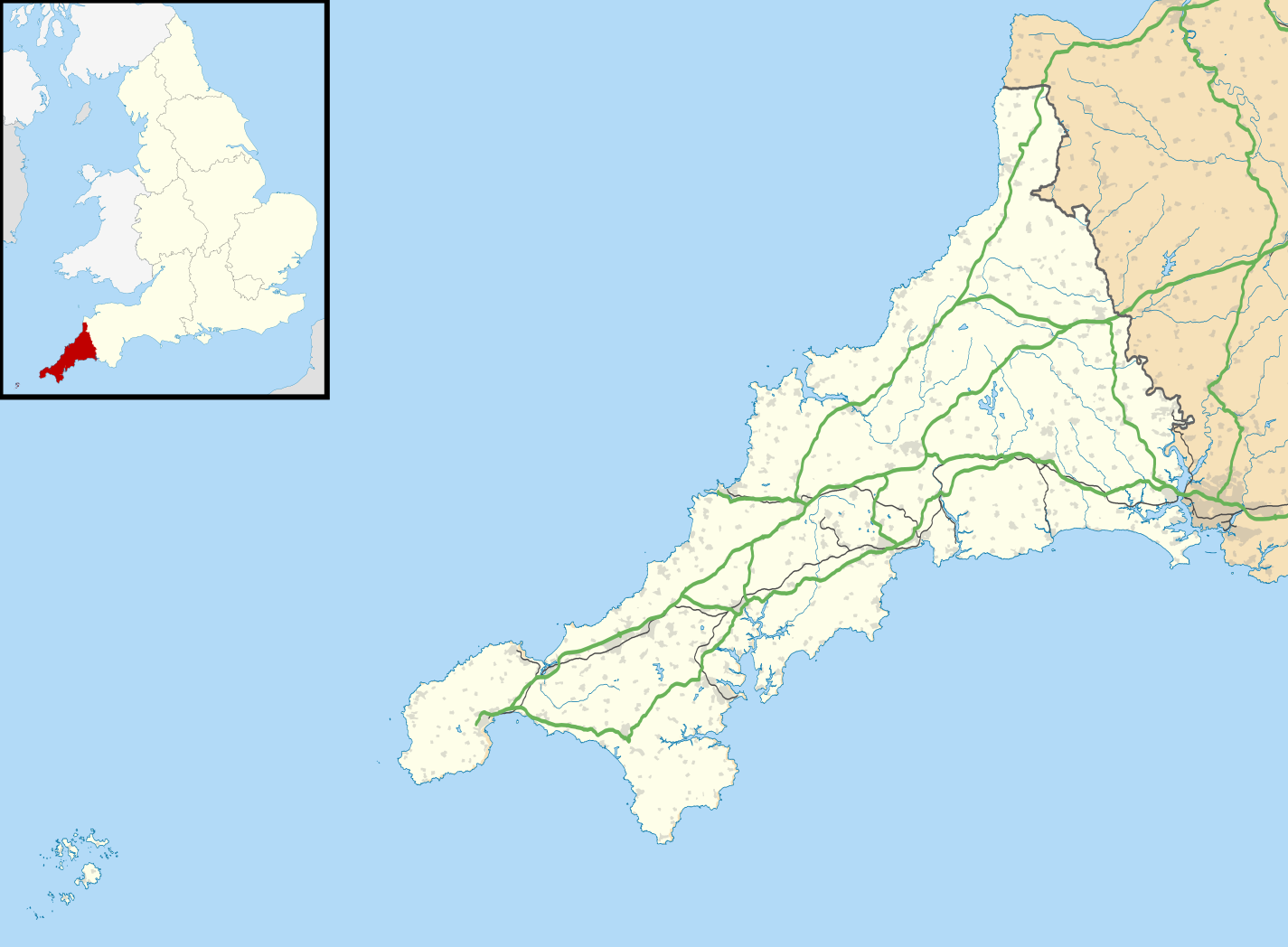
Localisation of Cornwall in the South West of England
Source: Wikipedia (image free of rights)

Nevertheless, the choice to develop fibre first in one region rather than another can have perverse effects. “Just as the rollout of railways in the 19th century defined the winners and losers for the next hundred years, the rollout of fibre to the premises networks will do the same in the 21st century. Our intention is that the South West will be one of the winners. So says Michael Maltby, CEO of Jurassic Fibre. Let’s hope that fibre doesn’t put territories in competition with each other and leave some behind. But there is no doubt that recent European projects have added value to Cornwall. One of the reasons for the slight increase in the region’s population, says Maltby, is that its digital infrastructure has definitely improved. As well as the picture postcard image that Cornwall offers, it is also becoming a favourite with the populations of the surrounding major cities, starting with Bristol, the nearest major city before London.

mannheim stadt
A view of Port Isaac, UK, a small village north of Newquay.
Source: Pexels (free of use)

The UK has chosen to move towards a vision of digital as a basic need. But access to the Internet is only one side of the coin, and the other side must ensure that these tools are understood. The demographic composition and geographical distribution of Cornwall’s population has forced the region to turn to digital technology to overcome challenges. Between the digital divide and the remoteness of many from major cities – and therefore from decent access to the internet, the peninsula has quickly become a model for the rest of the UK, but remains “largely neglected” within the European Union.

Sources:

– European Network for Rural Development, Cornwall-UK, Steps towards a digital rural region, 2019

– Olivier Vergnault, Hannah Finch, “Why the South West’s tech sector has been a saviour of the Covid-19 crisis”, Business Live, 2020